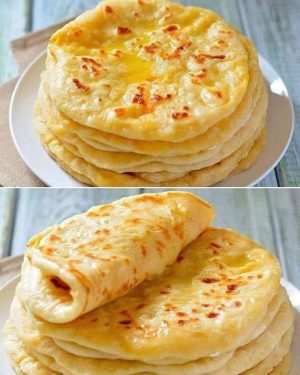
INGREDIENT
Dry Ingredients
- 3 cups (360 g) all-purpose flour
- 2 teaspoons instant yeast
- 1 teaspoon sugar
- 1 teaspoon salt
Wet Ingredients
- 1 cup warm water (about 40–43°C / 105–110°F)
- 2 tablespoons olive oil
Topping (Traditional)
- 1 egg yolk
- 1 tablespoon yogurt or milk
- Sesame seeds or nigella seeds (optional)
EQUIPMENT
- Air fryer (basket or oven-style)
- Large mixing bowl
- Measuring cups and spoons
- Wooden spoon or spatula
- Clean kitchen towel
- Parchment paper
- Pastry brush
STAGE 1: YEAST ACTIVATION
- Pour warm water into a mixing bowl.
- Add sugar and yeast.
- Stir gently and let rest for 5–10 minutes.
The mixture should become slightly foamy, indicating the yeast is active.
If no foam appears, replace the yeast before continuing.
STAGE 2: DOUGH MIXING
- Add olive oil to the yeast mixture.
- Add flour gradually, one cup at a time.
- Add salt after the first cup of flour to prevent direct contact with yeast.
- Mix until a soft, sticky dough forms.
Turkish bread dough should be soft and slightly sticky, not stiff.
STAGE 3: KNEADING (ESSENTIAL FOR SOFT TEXTURE)
- Transfer dough to a lightly floured surface.
- Knead for 8–10 minutes using this method:
- Push dough away with the heel of your hand
- Fold it back over itself
- Rotate slightly and repeat
The dough should become smooth, elastic, and stretchy.
Windowpane Test
Stretch a small piece of dough.
If it stretches thin without tearing, gluten is well developed.
STAGE 4: FIRST RISE (BULK FERMENTATION)
- Place dough in a lightly oiled bowl.
- Turn once to coat with oil.
- Cover with a damp towel or plastic wrap.
- Let rise for 60–90 minutes in a warm place.
The dough should double in size.
Ideal rising temperature: 24–27°C (75–80°F).
STAGE 5: SHAPING TURKISH BREAD
- Gently punch down the dough to release air.
- Transfer to a lightly floured surface.
- Shape into a round or oval flatbread, about:
- 18–20 cm wide
- 1.5–2 cm thick
- Place shaped dough on parchment paper.
STAGE 6: FINAL PROOFING
- Cover shaped dough loosely with a towel.
- Let rest for 20–30 minutes until slightly puffy.
Do not overproof, as this can cause the bread to collapse during cooking.
STAGE 7: TOPPING AND TRADITIONAL PATTERN
- Mix egg yolk with yogurt or milk.
- Brush gently over the surface of the dough.
- Use fingertips to press shallow indentations across the surface, forming a classic Turkish bread pattern.
- Sprinkle sesame or nigella seeds if desired.
STAGE 8: PREHEATING THE AIR FRYER
- Preheat air fryer to 170°C (340°F) for 5 minutes.
Lower temperature ensures the bread cooks through without burning the top.
STAGE 9: AIR FRYING THE TURKISH BREAD
- Carefully place bread with parchment paper into the air fryer basket.
- Cook at:
- 170°C (340°F) for 10 minutes
- After 10 minutes:
- Cover loosely with foil to prevent over-browning
- Reduce temperature to 160°C (320°F)
- Continue cooking for another 8–12 minutes.
Total cooking time
18–22 minutes, depending on air fryer size and bread thickness.
STAGE 10: DONENESS CHECK
The bread is fully cooked when:
- The surface is golden
- The bottom is lightly browned
- The bread sounds hollow when tapped
- Internal temperature reaches about 93°C (200°F)
STAGE 11: COOLING (IMPORTANT)
- Remove bread from air fryer.
- Place on a wire rack.
- Allow to cool for at least 20 minutes before slicing.
Cutting too early releases steam and makes the bread gummy.
SERVING SUGGESTIONS
- Serve warm with butter, cheese, or honey
- Use as sandwich bread
- Pair with soups, stews, or kebabs
- Ideal for dipping in olive oil or yogurt-based sauces
ADDITIONAL TIPS FOR PERFECT AIR FRYER TURKISH BREAD
- Soft Dough: A slightly sticky dough creates a light crumb.
- Do Not Overbake: Air fryers cook faster than ovens.
- Even Thickness: Ensures uniform cooking.
- Foil Covering: Prevents excessive browning while allowing full internal baking.
- Freshness: Best consumed the same day but can be reheated lightly.
