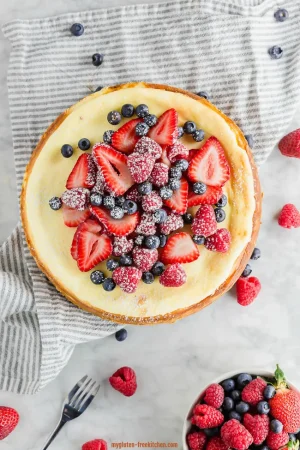
Ingredients
For the Gluten-Free Crust
- 200 g gluten-free digestive biscuits or graham crackers
- 100 g unsalted butter, melted
- 2 tablespoons granulated sugar (optional, for extra sweetness)
- 1/2 teaspoon cinnamon (optional, adds warmth)
For the Cheesecake Filling
- 900 g full-fat cream cheese, at room temperature
- 200 g granulated sugar
- 3 large eggs, at room temperature
- 1 teaspoon pure vanilla extract
- 240 ml sour cream, at room temperature
- 2 tablespoons gluten-free all-purpose flour or cornstarch (stabilizes the filling)
- Zest of 1 lemon (optional, adds brightness)
Optional Toppings
- Fresh berries
- Fruit compote
- Whipped cream
- Chocolate ganache
Equipment Needed
- 9-inch springform pan
- Parchment paper
- Mixing bowls
- Electric mixer or stand mixer
- Rubber spatula
- Measuring cups and spoons
- Small saucepan or kettle for hot water bath
- Aluminum foil
Part 1: Preparing the Pan
- Preheat oven to 160°C (325°F).
- Line the base of the springform pan with parchment paper.
- Lightly grease the sides with butter or non-stick spray.
- Wrap the outside of the pan with a double layer of aluminum foil to prevent water leakage during the water bath.
Part 2: Making the Gluten-Free Crust
Step 1: Crushing Cookies
- Place gluten-free biscuits in a food processor or a zip-lock bag.
- Crush until fine crumbs form.
- Optional: add sugar and cinnamon to the crumbs.
Step 2: Binding the Crust
- Pour melted butter over crumbs.
- Mix until evenly combined. The texture should be like wet sand.
Step 3: Pressing the Crust
- Transfer crumbs to the prepared springform pan.
- Press firmly into an even layer on the bottom (about 1 cm thick).
- Use the back of a spoon or a flat-bottomed glass for smooth surface.
Step 4: Pre-Baking (Optional but Recommended)
- Bake crust for 8–10 minutes at 160°C.
- Remove and cool slightly while preparing the filling.
Pre-baking prevents soggy bottom.
Part 3: Preparing the Filling
Step 1: Cream Cheese
- Place room-temperature cream cheese in a mixing bowl.
- Beat on medium speed until smooth and lump-free.
Step 2: Adding Sugar
- Gradually add sugar, 1–2 tablespoons at a time.
- Beat until incorporated. Avoid overbeating (which can trap air and cause cracks).
Step 3: Adding Eggs
- Add eggs one at a time, beating gently after each.
- Scrape down sides of the bowl to ensure uniform texture.
Step 4: Flavor and Stabilizer
- Beat in vanilla extract and lemon zest (if using).
- Add sour cream and gluten-free flour or cornstarch.
- Mix on low speed until smooth and homogenous.
Step 5: Avoiding Overmixing
- Do not overmix at any stage.
- Too much air = cracks in the cheesecake.
Part 4: Assembling
- Pour filling over pre-baked crust.
- Smooth the top with a spatula.
- Tap gently on counter to release air bubbles.
Part 5: Baking (Water Bath Method)
Step 1: Preparing the Water Bath
- Place springform pan in a larger roasting pan.
- Boil 1–2 cups of water and pour into the roasting pan around the cheesecake.
- Water should reach halfway up the sides of the springform pan.
Step 2: Baking
- Bake at 160°C for 50–60 minutes.
- Cheesecake is done when edges are set but the center still jiggles slightly.
Step 3: Cooling in Oven
- Turn off oven and leave cheesecake inside with door ajar for 30 minutes.
- Prevents sudden temperature change and cracking.
Part 6: Chilling
- Remove cheesecake from water bath.
- Cool completely at room temperature (about 1 hour).
- Refrigerate for at least 4 hours, preferably overnight.
Part 7: Serving
- Remove cheesecake from springform pan.
- Slice with a hot, clean knife for neat edges.
- Serve plain or with toppings such as fresh berries, compote, or whipped cream.
